Published: August 2026
Category: Solar Industry | Renewable Energy
Reading Time: 4–5 minutes
India’s solar energy journey continues to gather momentum.
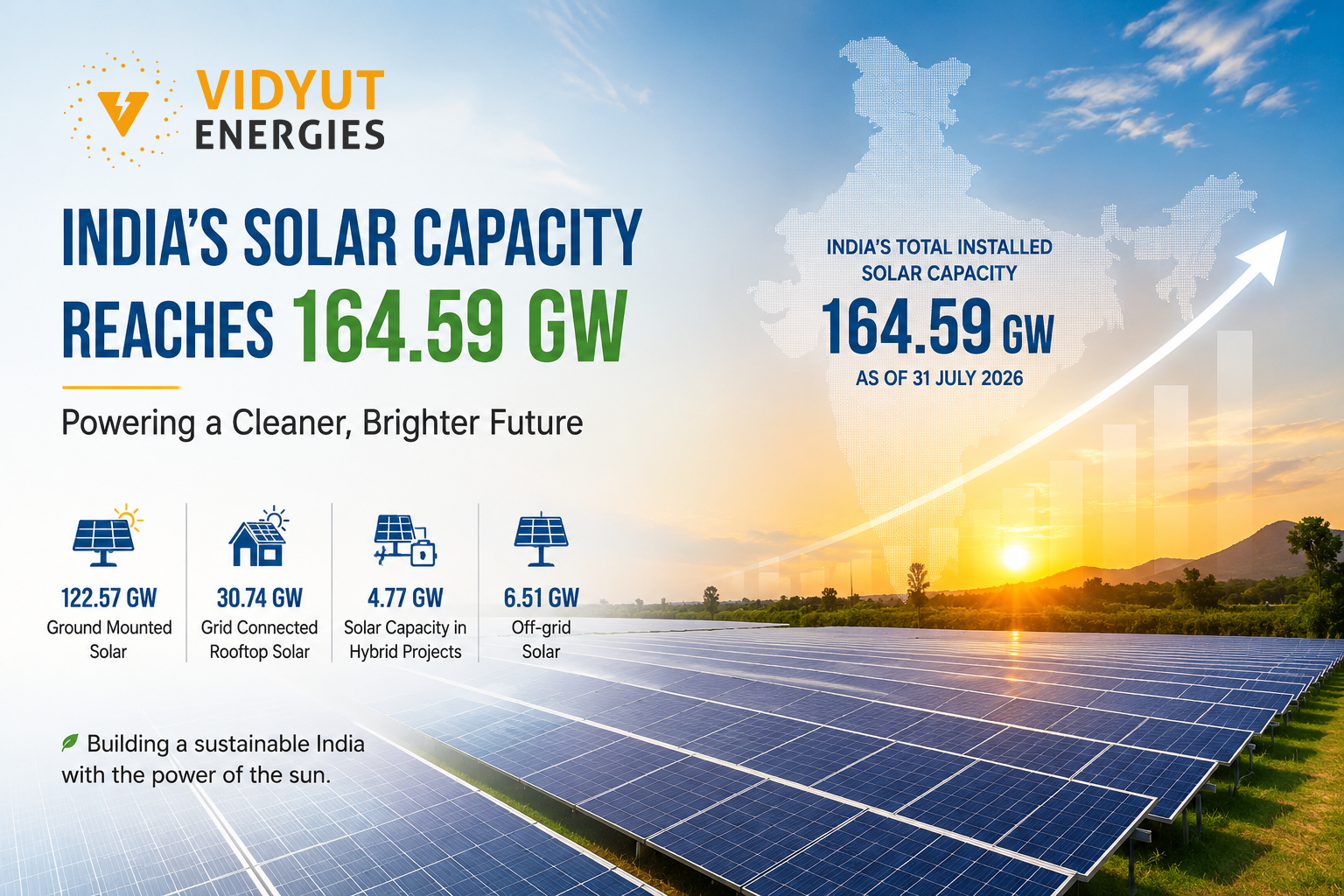
According to the latest data published by the Ministry of New and Renewable Energy (MNRE), India’s cumulative installed solar power capacity reached approximately 164.59 GW as of 31 July 2026.
The milestone reflects more than just growth in installed capacity. It demonstrates how rapidly solar power is becoming part of India’s mainstream energy infrastructure — across utility-scale projects, commercial and industrial facilities, homes and decentralised energy applications.
Understanding India’s 164.59 GW Solar Portfolio
MNRE’s latest figures show that India’s cumulative solar capacity includes approximately:
- 122.57 GW of ground-mounted solar
- 30.74 GW of grid-connected rooftop solar
- 4.77 GW of solar capacity within hybrid projects
- 6.51 GW of off-grid solar
During the period from 1 April to 31 July 2026 alone, approximately 14.33 GW of solar capacity was added.
These numbers indicate the scale at which India’s solar ecosystem is evolving.
Rooftop Solar Is Becoming Increasingly Important
While large ground-mounted projects account for the majority of India’s installed solar capacity, rooftop solar has developed into a significant segment of the market.
With more than 30 GW of grid-connected rooftop capacity, solar is increasingly being generated closer to where electricity is actually consumed.
For homes, businesses and industries, this can create several advantages:
- Reduced dependence on grid electricity
- Better control over long-term energy expenditure
- Productive utilisation of otherwise unused rooftop space
- Progress towards sustainability and decarbonisation objectives
- Greater participation in India’s transition towards distributed clean energy
For commercial and industrial consumers in particular, electricity is not merely a utility expense — it directly influences operating costs.
A properly engineered solar system can therefore become a long-term energy asset rather than simply another infrastructure investment.
Why Solar Project Quality Matters More as the Market Grows
Rapid market growth also makes engineering quality increasingly important.
Solar installations are expected to operate for decades. Project performance therefore depends on much more than simply installing photovoltaic modules.
A reliable solar project requires careful consideration of:
Site Assessment
Available area, irradiation, shading, structural conditions and electrical infrastructure must be properly evaluated.
System Engineering
Module configuration, inverter selection, electrical design, cable sizing and system losses influence long-term generation.
Component Selection
Equipment should be selected not merely on upfront price but also on reliability, compatibility, compliance and lifecycle performance.
Installation Quality
Even well-designed systems can underperform when execution standards are compromised.
Monitoring & Maintenance
Generation should be continuously monitored so abnormalities can be detected before they develop into prolonged performance losses.
This is why choosing the right engineering and execution partner remains an important part of any solar investment.
The Opportunity Ahead
India’s 164.59 GW milestone demonstrates how far the solar industry has progressed, but it also highlights the scale of opportunity still ahead.
Growing electricity demand, improvements in solar technology, policy support and increasing focus on sustainable business practices continue to strengthen the case for renewable energy.
For industries and commercial establishments evaluating solar, the question is increasingly moving from:
“Should we adopt solar?”
to:
“How should we design the right solar solution for our energy requirements?”
Building the Next Phase of India’s Solar Growth
At Vidyut Energies Pvt. Ltd., we believe successful solar adoption begins with understanding the customer’s actual energy requirements.
From assessment and engineering to execution and long-term support, every stage contributes to the performance of a solar asset.
As India’s installed solar capacity continues to expand, our focus remains on helping businesses and communities participate in the clean-energy transition through reliable and thoughtfully engineered solar solutions.
Powering Today | Energising Tomorrow
Source: Ministry of New and Renewable Energy (MNRE), Government of India — Physical Achievements, cumulative progress as on 31 July 2026.
Figures and policy information referenced in this article are based on information published by MNRE and may subsequently be revised or updated.
Leave a Reply