Blog

  • ALMM List-II and the Changing Solar Supply Chain: Why Quality and Traceability Matter

    ALMM List-II and the Changing Solar Supply Chain: Why Quality and Traceability Matter

    Published: August 2026
    Category: Solar Policy | Solar Technology | Industry Updates
    Reading Time: 5 minutes

    India’s solar industry is not only expanding in installed capacity — the ecosystem behind solar manufacturing, procurement and project execution is also evolving.

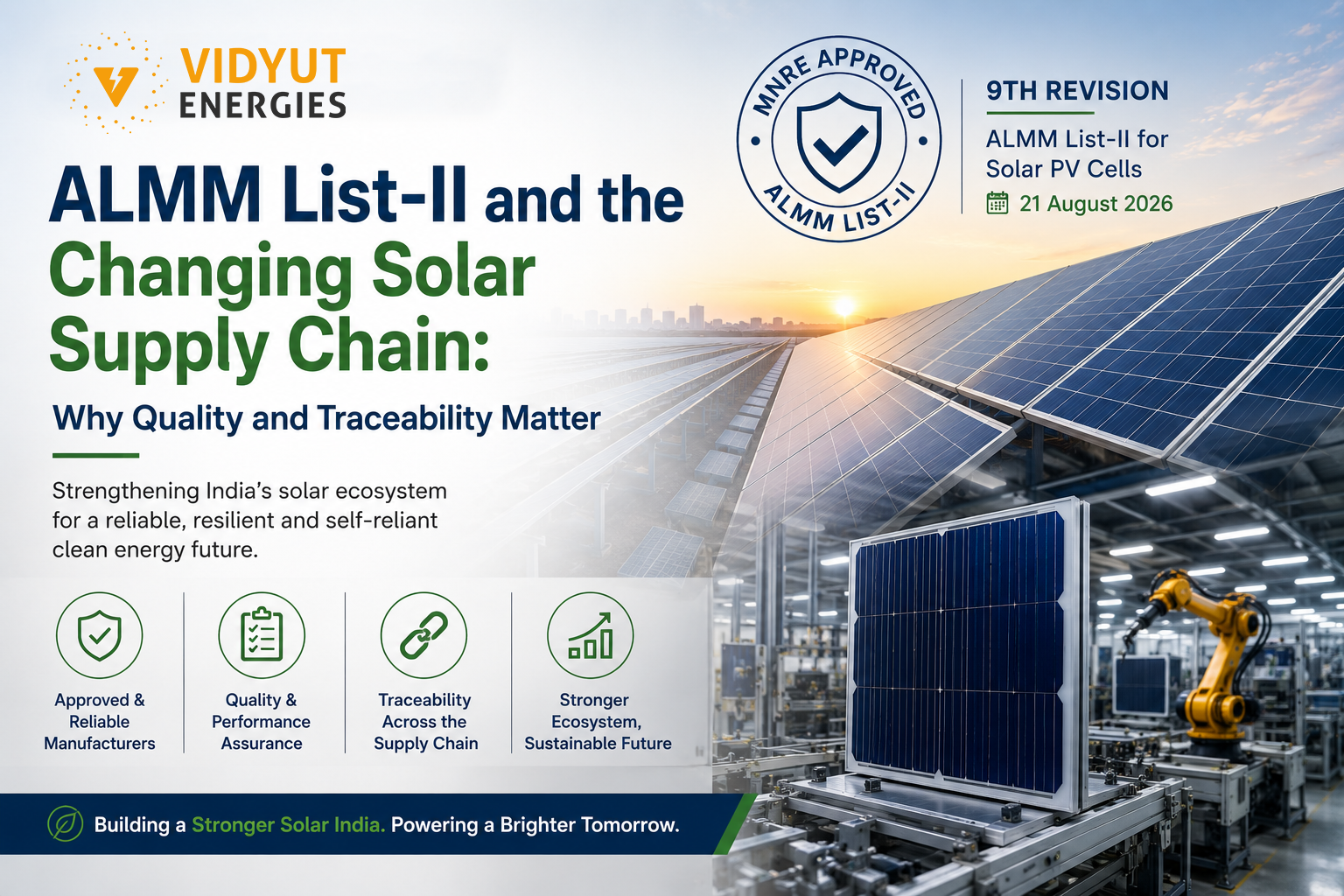
    On 21 August 2026, the Ministry of New and Renewable Energy (MNRE) published the 9th Revision of ALMM List-II for Solar PV Cells.

    For project developers, EPC companies and solar customers, developments around the Approved List of Models and Manufacturers (ALMM) highlight an important principle:

    The long-term success of a solar project depends not only on capacity and cost, but also on the quality, reliability and traceability of the equipment behind it.

    What Is ALMM?

    ALMM stands for the Approved List of Models and Manufacturers.

    MNRE introduced the ALMM framework for solar photovoltaic modules with an objective that includes ensuring reliability of manufacturers, protecting consumer interests and strengthening India’s energy security.

    The framework includes:

    • List-I for solar PV modules
    • List-II for solar PV cells

    The first ALMM list for solar PV modules was issued in March 2021, while the first List-II for solar PV cells was issued in July 2025.

    MNRE continues to update these lists as India’s domestic solar manufacturing ecosystem develops.

    Why Does Component Traceability Matter?

    A solar power plant is expected to operate for many years.

    That makes component reliability particularly important.

    When evaluating a solar project, customers often naturally focus on:

    • Project cost
    • Installed capacity
    • Expected generation
    • Payback period

    These are important considerations, but they should not be viewed in isolation.

    The origin, quality, certification, compatibility and long-term reliability of system components can directly influence the performance of the asset.

    This is particularly relevant when solar installations are expected to operate over long periods under demanding environmental conditions.

    India’s Solar Market Is Maturing

    The continued evolution of the ALMM framework also reflects a broader change in India’s solar industry.

    The conversation is moving beyond simply increasing installed capacity towards developing a more robust solar ecosystem encompassing:

    Manufacturing → Quality → Traceability → Engineering → Installation → Monitoring → Long-Term Performance

    This maturation is important for customers.

    A rapidly growing market can create a wide range of equipment and pricing choices. But the lowest initial project cost does not automatically translate into the best lifecycle value.

    What Should Businesses Consider When Selecting a Solar EPC Partner?

    For commercial and industrial organisations planning solar projects, equipment selection should form part of a broader engineering and procurement strategy.

    Before finalising a project, businesses should consider asking:

    Are the proposed components suitable for the project?

    Equipment should be selected according to the project’s technical requirements rather than simply because it is readily available.

    Are applicable regulatory requirements being considered?

    Solar policies and compliance requirements continue to evolve. Project design and procurement should therefore account for rules applicable to the specific project category.

    Is component compatibility being evaluated?

    Modules, inverters, structures, protection systems and electrical infrastructure must function as an integrated system.

    What warranties and support are available?

    Long-term equipment availability and after-sales support can become important during the operational life of the plant.

    Is lifecycle performance being considered?

    Solar should be evaluated as a long-term energy investment rather than purely on upfront EPC price.

    Quality Engineering Creates Long-Term Value

    A well-executed solar project combines appropriate technology with sound engineering, procurement, installation and maintenance.

    At Vidyut Energies Pvt. Ltd., our approach is centred on understanding project requirements and developing solar solutions with long-term performance in mind.

    As India’s solar manufacturing and regulatory ecosystem continues to mature, informed equipment selection and responsible engineering will remain fundamental to building dependable solar infrastructure.

    The future of solar is not simply about installing more megawatts.

    It is about building better megawatts.

    Powering Today | Energising Tomorrow


    Source: Ministry of New and Renewable Energy (MNRE), Government of India — Approved List of Models and Manufacturers (ALMM); 9th Revision of ALMM List-II for Solar PV Cells dated 21 August 2026.

    ALMM requirements vary according to project category and applicable government notifications. Readers should consult the latest MNRE orders and guidelines before making procurement or compliance decisions.
  • Smarter Rooftop Solar: Why Inverter-Level Generation Data Matters

    Smarter Rooftop Solar: Why Inverter-Level Generation Data Matters

    Published: August 2026
    Category: Rooftop Solar | Solar Technology
    Reading Time: 4 minutes

    Installing a rooftop solar system is only the beginning.

    Understanding how that system performs throughout its operating life is equally important.

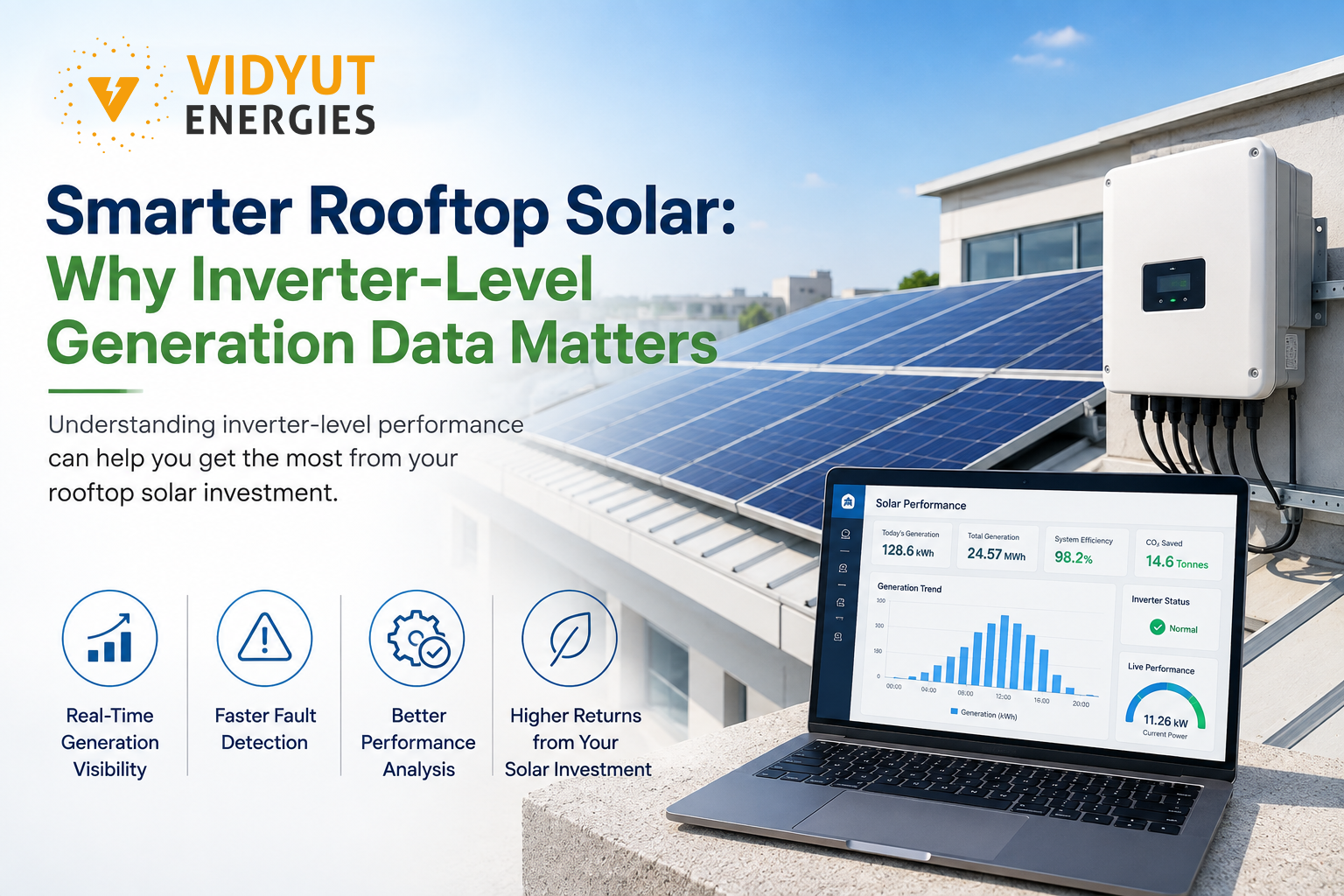
    In August 2026, the Ministry of New and Renewable Energy (MNRE) issued a notice concerning compliance with guidelines related to inverter-level generation data and storage of inverter-level data for rooftop solar systems.

    The development highlights an increasingly important direction for India’s rooftop solar ecosystem: solar systems need to become more measurable, transparent and data-driven.

    Why Is the Inverter So Important?

    Solar modules generate DC electricity, while most homes, businesses and grid-connected equipment operate using AC electricity.

    The solar inverter performs the critical task of converting this DC electricity into usable AC electricity.

    Modern inverters can also provide valuable operating information about the solar installation.

    Depending on the system and monitoring architecture, this information can help understand:

    • Energy generation
    • Inverter operating status
    • System availability
    • Performance trends
    • Faults and alerts
    • Abnormal generation patterns

    That makes the inverter an important source of information about how a solar installation is actually performing.

    From Solar Installation to Solar Intelligence

    Traditional discussions around solar often concentrate on installed capacity.

    A customer may ask:

    “How many kilowatts of solar have been installed?”

    But the more important long-term question is:

    “How effectively is that installed capacity generating electricity?”

    This distinction matters.

    Two solar systems with the same installed capacity can produce different results because of factors such as shading, module orientation, equipment condition, soiling, temperature, electrical losses, downtime and maintenance practices.

    Generation data helps transform these conditions into measurable information.

    Why Data Visibility Benefits Solar Owners

    Better monitoring can provide several practical benefits.

    Faster Identification of Problems

    A significant decline in generation can indicate a technical problem that requires investigation.

    Without monitoring, an underperforming system could potentially continue operating below expectations without attracting immediate attention.

    Better Performance Analysis

    Historical generation information allows system owners and service teams to compare performance over time and identify unusual trends.

    Improved Maintenance

    Data can help maintenance teams move towards a more proactive approach rather than relying entirely on periodic physical inspections.

    Greater Transparency

    For customers, accessible generation information provides better visibility into the performance of their solar investment.

    What This Means for Rooftop Solar Projects

    The broader message for the industry is clear.

    Solar EPC is evolving beyond:

    Design → Install → Commission

    towards:

    Design → Install → Commission → Monitor → Maintain → Optimise

    Long-term performance must increasingly become part of the conversation from the beginning of a project.

    Businesses evaluating rooftop solar should therefore consider monitoring capability alongside module specifications, inverter efficiency and project cost.

    Questions worth asking include:

    • What monitoring capabilities will the system provide?
    • Can generation be reviewed at an appropriate level?
    • How will faults or abnormal performance be identified?
    • How will historical data be maintained?
    • Who will respond when performance issues are detected?

    These questions can have a meaningful impact on the long-term value of the solar installation.

    Engineering for Long-Term Performance

    At Vidyut Energies Pvt. Ltd., we view a solar installation as a long-term energy asset.

    Good engineering should therefore consider not only how a system performs on commissioning day, but how effectively its performance can be understood and maintained throughout its operating life.

    As India’s rooftop solar ecosystem matures, monitoring, data visibility and proactive maintenance are likely to play an increasingly important role in delivering dependable solar performance.

    Powering Today | Energising Tomorrow


    Source: Ministry of New and Renewable Energy (MNRE), Government of India — Notice concerning compliance with guidelines for inverter-level generation data and storage of inverter-level data of rooftop solar systems, dated 17 August 2026.

    Readers and project stakeholders should refer to the latest applicable MNRE guidelines and official notifications for specific technical and compliance requirements.

  • India’s Solar Capacity Reaches 164.59 GW: What It Means for India’s Clean Energy Future

    India’s Solar Capacity Reaches 164.59 GW: What It Means for India’s Clean Energy Future

    Published: August 2026
    Category: Solar Industry | Renewable Energy
    Reading Time: 4–5 minutes

    India’s solar energy journey continues to gather momentum.

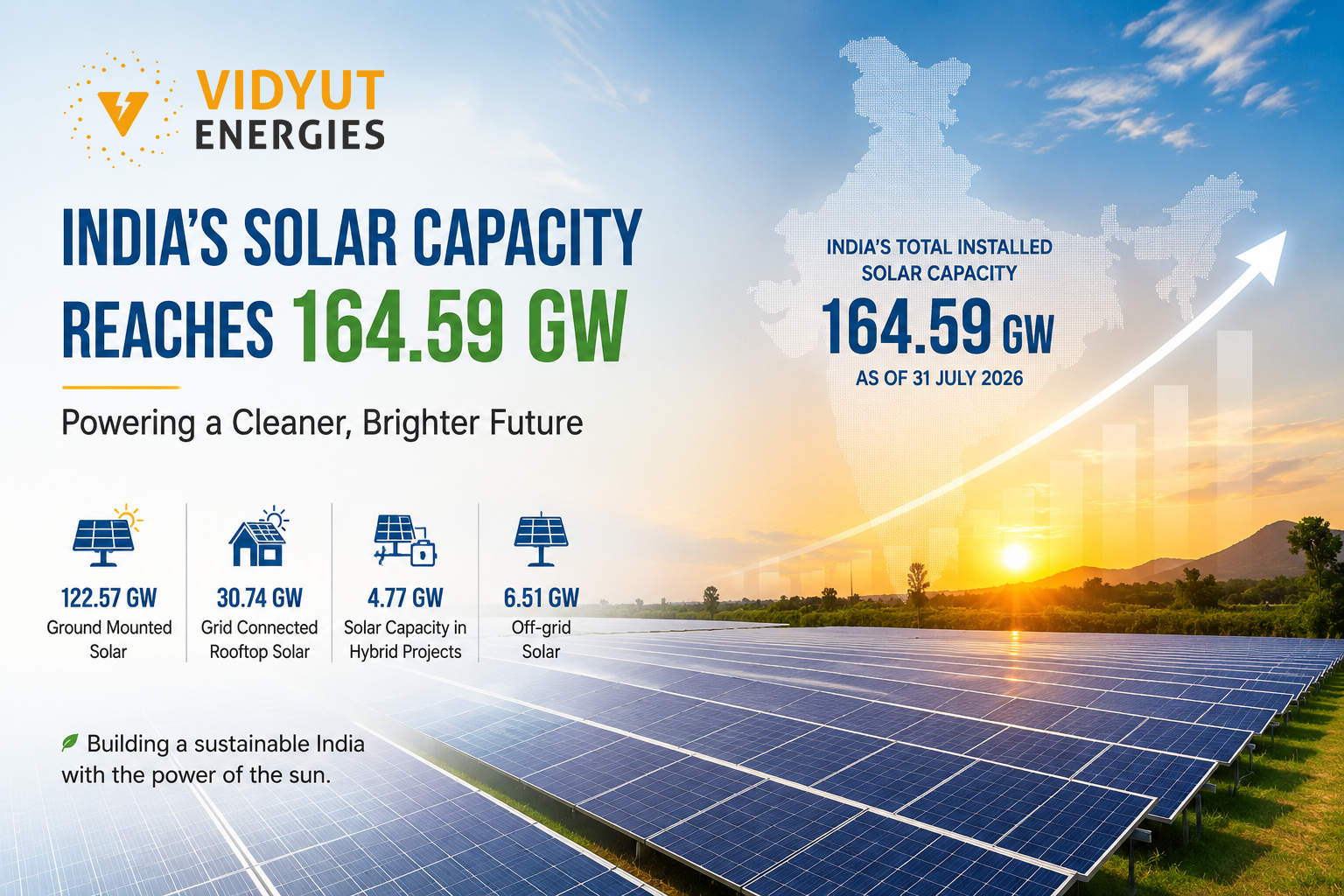
    According to the latest data published by the Ministry of New and Renewable Energy (MNRE), India’s cumulative installed solar power capacity reached approximately 164.59 GW as of 31 July 2026.

    The milestone reflects more than just growth in installed capacity. It demonstrates how rapidly solar power is becoming part of India’s mainstream energy infrastructure — across utility-scale projects, commercial and industrial facilities, homes and decentralised energy applications.

    Understanding India’s 164.59 GW Solar Portfolio

    MNRE’s latest figures show that India’s cumulative solar capacity includes approximately:

    • 122.57 GW of ground-mounted solar
    • 30.74 GW of grid-connected rooftop solar
    • 4.77 GW of solar capacity within hybrid projects
    • 6.51 GW of off-grid solar

    During the period from 1 April to 31 July 2026 alone, approximately 14.33 GW of solar capacity was added.

    These numbers indicate the scale at which India’s solar ecosystem is evolving.

    Rooftop Solar Is Becoming Increasingly Important

    While large ground-mounted projects account for the majority of India’s installed solar capacity, rooftop solar has developed into a significant segment of the market.

    With more than 30 GW of grid-connected rooftop capacity, solar is increasingly being generated closer to where electricity is actually consumed.

    For homes, businesses and industries, this can create several advantages:

    • Reduced dependence on grid electricity
    • Better control over long-term energy expenditure
    • Productive utilisation of otherwise unused rooftop space
    • Progress towards sustainability and decarbonisation objectives
    • Greater participation in India’s transition towards distributed clean energy

    For commercial and industrial consumers in particular, electricity is not merely a utility expense — it directly influences operating costs.

    A properly engineered solar system can therefore become a long-term energy asset rather than simply another infrastructure investment.

    Why Solar Project Quality Matters More as the Market Grows

    Rapid market growth also makes engineering quality increasingly important.

    Solar installations are expected to operate for decades. Project performance therefore depends on much more than simply installing photovoltaic modules.

    A reliable solar project requires careful consideration of:

    Site Assessment
    Available area, irradiation, shading, structural conditions and electrical infrastructure must be properly evaluated.

    System Engineering
    Module configuration, inverter selection, electrical design, cable sizing and system losses influence long-term generation.

    Component Selection
    Equipment should be selected not merely on upfront price but also on reliability, compatibility, compliance and lifecycle performance.

    Installation Quality
    Even well-designed systems can underperform when execution standards are compromised.

    Monitoring & Maintenance
    Generation should be continuously monitored so abnormalities can be detected before they develop into prolonged performance losses.

    This is why choosing the right engineering and execution partner remains an important part of any solar investment.

    The Opportunity Ahead

    India’s 164.59 GW milestone demonstrates how far the solar industry has progressed, but it also highlights the scale of opportunity still ahead.

    Growing electricity demand, improvements in solar technology, policy support and increasing focus on sustainable business practices continue to strengthen the case for renewable energy.

    For industries and commercial establishments evaluating solar, the question is increasingly moving from:

    “Should we adopt solar?”

    to:

    “How should we design the right solar solution for our energy requirements?”

    Building the Next Phase of India’s Solar Growth

    At Vidyut Energies Pvt. Ltd., we believe successful solar adoption begins with understanding the customer’s actual energy requirements.

    From assessment and engineering to execution and long-term support, every stage contributes to the performance of a solar asset.

    As India’s installed solar capacity continues to expand, our focus remains on helping businesses and communities participate in the clean-energy transition through reliable and thoughtfully engineered solar solutions.

    Powering Today | Energising Tomorrow


    Source: Ministry of New and Renewable Energy (MNRE), Government of India — Physical Achievements, cumulative progress as on 31 July 2026.

    Figures and policy information referenced in this article are based on information published by MNRE and may subsequently be revised or updated.

  • We’re Hiring — Executive – Operations

    Coordinate. Execute. Keep things moving.

    Vidyut Energies Pvt. Ltd. is looking for a proactive and organised Executive – Operations to support day-to-day operational activities and ensure smooth coordination across teams and projects.

    📍 Location: Jodhpur, Rajasthan, India
    💼 Position: Executive – Operations
    👤 Vacancy: 1
    🏢 Employment Type: Full-Time

    Key Responsibilities

    • Coordinate day-to-day operational and administrative activities
    • Support project teams with documentation, scheduling and follow-ups
    • Coordinate with internal teams, vendors, suppliers and other stakeholders
    • Maintain operational records, reports and project-related documentation
    • Track tasks, requirements and project progress to ensure timely execution
    • Assist with procurement, logistics and material coordination as required
    • Identify operational issues and coordinate with concerned teams for resolution
    • Support management with regular operational updates and reports

    Candidate Profile

    • Graduate in any discipline; business, commerce or management background preferred
    • Prior experience in operations, project coordination or administration is preferred
    • Proficiency in MS Office / Google Workspace
    • Strong organisational, communication and follow-up skills
    • Ability to manage multiple tasks and priorities effectively
    • Detail-oriented with a responsible and solution-focused approach
    • Experience in the solar, renewable energy, EPC or infrastructure sector will be an advantage

    Why Join Vidyut Energies?

    Be part of a growing renewable energy company where your coordination and operational skills directly contribute to the successful execution of solar energy projects.

    Ready to grow your career with renewable energy?

    Apply Now →

    Vidyut Energies Pvt. Ltd.
    Powering Today | Energising Tomorrow

  • We’re Hiring — Civil Engineers

    Build projects that power a sustainable future.

    Vidyut Energies Pvt. Ltd. is expanding its project execution team and looking for Civil Engineers to support our growing solar energy projects.

    📍 Location: Jodhpur, Rajasthan, India
    💼 Position: Civil Engineer – Solar Projects
    👥 Vacancies: 2
    🏢 Employment Type: Full-Time

    Key Responsibilities

    • Supervise and coordinate civil works at solar project sites
    • Execute foundations, mounting structures and related site development works
    • Review drawings, layouts and technical specifications
    • Monitor contractors, manpower, materials and daily site progress
    • Ensure work meets required quality and safety standards
    • Coordinate with electrical, structural and project execution teams
    • Maintain site documentation and progress reports

    Candidate Profile

    • Diploma / B.E. / B.Tech in Civil Engineering
    • Experience in solar, infrastructure, industrial or construction projects preferred
    • Good understanding of civil drawings and site execution
    • Strong coordination and problem-solving skills
    • Willingness to work at project sites and travel when required

    Experience: Freshers and experienced candidates may apply.*

    Why Join Vidyut Energies?

    Be part of India’s growing renewable energy sector and gain hands-on experience working on real-world solar infrastructure projects with opportunities to learn, contribute and grow.

    Ready to build your career in renewable energy?

    Apply Now →

    Vidyut Energies Pvt. Ltd.
    Powering Today | Energising Tomorrow