
Category: Blog

  • ALMM List-II and the Changing Solar Supply Chain: Why Quality and Traceability Matter

    ALMM List-II and the Changing Solar Supply Chain: Why Quality and Traceability Matter

    Published: August 2026
    Category: Solar Policy | Solar Technology | Industry Updates
    Reading Time: 5 minutes

    India’s solar industry is not only expanding in installed capacity — the ecosystem behind solar manufacturing, procurement and project execution is also evolving.

    On 21 August 2026, the Ministry of New and Renewable Energy (MNRE) published the 9th Revision of ALMM List-II for Solar PV Cells.

    For project developers, EPC companies and solar customers, developments around the Approved List of Models and Manufacturers (ALMM) highlight an important principle:

    The long-term success of a solar project depends not only on capacity and cost, but also on the quality, reliability and traceability of the equipment behind it.

    What Is ALMM?

    ALMM stands for the Approved List of Models and Manufacturers.

    MNRE introduced the ALMM framework for solar photovoltaic modules with an objective that includes ensuring reliability of manufacturers, protecting consumer interests and strengthening India’s energy security.

    The framework includes:

    • List-I for solar PV modules
    • List-II for solar PV cells

    The first ALMM list for solar PV modules was issued in March 2021, while the first List-II for solar PV cells was issued in July 2025.

    MNRE continues to update these lists as India’s domestic solar manufacturing ecosystem develops.

    Why Does Component Traceability Matter?

    A solar power plant is expected to operate for many years.

    That makes component reliability particularly important.

    When evaluating a solar project, customers often naturally focus on:

    • Project cost
    • Installed capacity
    • Expected generation
    • Payback period

    These are important considerations, but they should not be viewed in isolation.

    The origin, quality, certification, compatibility and long-term reliability of system components can directly influence the performance of the asset.

    This is particularly relevant when solar installations are expected to operate over long periods under demanding environmental conditions.

    India’s Solar Market Is Maturing

    The continued evolution of the ALMM framework also reflects a broader change in India’s solar industry.

    The conversation is moving beyond simply increasing installed capacity towards developing a more robust solar ecosystem encompassing:

    Manufacturing → Quality → Traceability → Engineering → Installation → Monitoring → Long-Term Performance

    This maturation is important for customers.

    A rapidly growing market can create a wide range of equipment and pricing choices. But the lowest initial project cost does not automatically translate into the best lifecycle value.

    What Should Businesses Consider When Selecting a Solar EPC Partner?

    For commercial and industrial organisations planning solar projects, equipment selection should form part of a broader engineering and procurement strategy.

    Before finalising a project, businesses should consider asking:

    Are the proposed components suitable for the project?

    Equipment should be selected according to the project’s technical requirements rather than simply because it is readily available.

    Are applicable regulatory requirements being considered?

    Solar policies and compliance requirements continue to evolve. Project design and procurement should therefore account for rules applicable to the specific project category.

    Is component compatibility being evaluated?

    Modules, inverters, structures, protection systems and electrical infrastructure must function as an integrated system.

    What warranties and support are available?

    Long-term equipment availability and after-sales support can become important during the operational life of the plant.

    Is lifecycle performance being considered?

    Solar should be evaluated as a long-term energy investment rather than purely on upfront EPC price.

    Quality Engineering Creates Long-Term Value

    A well-executed solar project combines appropriate technology with sound engineering, procurement, installation and maintenance.

    At Vidyut Energies Pvt. Ltd., our approach is centred on understanding project requirements and developing solar solutions with long-term performance in mind.

    As India’s solar manufacturing and regulatory ecosystem continues to mature, informed equipment selection and responsible engineering will remain fundamental to building dependable solar infrastructure.

    The future of solar is not simply about installing more megawatts.

    It is about building better megawatts.

    Powering Today | Energising Tomorrow


    Source: Ministry of New and Renewable Energy (MNRE), Government of India — Approved List of Models and Manufacturers (ALMM); 9th Revision of ALMM List-II for Solar PV Cells dated 21 August 2026.

    ALMM requirements vary according to project category and applicable government notifications. Readers should consult the latest MNRE orders and guidelines before making procurement or compliance decisions.
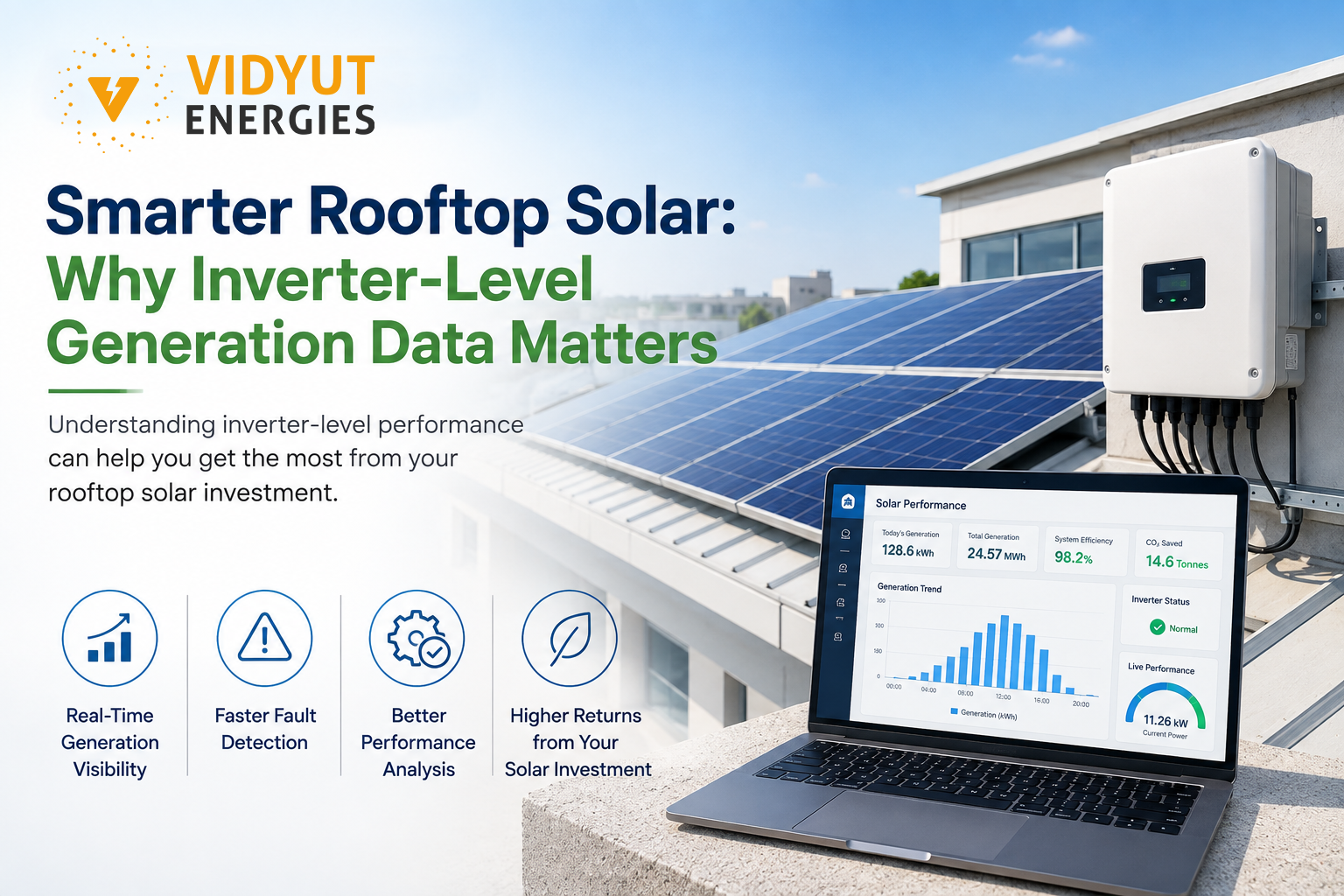
  • Smarter Rooftop Solar: Why Inverter-Level Generation Data Matters

    Smarter Rooftop Solar: Why Inverter-Level Generation Data Matters

    Published: August 2026
    Category: Rooftop Solar | Solar Technology
    Reading Time: 4 minutes

    Installing a rooftop solar system is only the beginning.

    Understanding how that system performs throughout its operating life is equally important.

    In August 2026, the Ministry of New and Renewable Energy (MNRE) issued a notice concerning compliance with guidelines related to inverter-level generation data and storage of inverter-level data for rooftop solar systems.

    The development highlights an increasingly important direction for India’s rooftop solar ecosystem: solar systems need to become more measurable, transparent and data-driven.

    Why Is the Inverter So Important?

    Solar modules generate DC electricity, while most homes, businesses and grid-connected equipment operate using AC electricity.

    The solar inverter performs the critical task of converting this DC electricity into usable AC electricity.

    Modern inverters can also provide valuable operating information about the solar installation.

    Depending on the system and monitoring architecture, this information can help understand:

    • Energy generation
    • Inverter operating status
    • System availability
    • Performance trends
    • Faults and alerts
    • Abnormal generation patterns

    That makes the inverter an important source of information about how a solar installation is actually performing.

    From Solar Installation to Solar Intelligence

    Traditional discussions around solar often concentrate on installed capacity.

    A customer may ask:

    “How many kilowatts of solar have been installed?”

    But the more important long-term question is:

    “How effectively is that installed capacity generating electricity?”

    This distinction matters.

    Two solar systems with the same installed capacity can produce different results because of factors such as shading, module orientation, equipment condition, soiling, temperature, electrical losses, downtime and maintenance practices.

    Generation data helps transform these conditions into measurable information.

    Why Data Visibility Benefits Solar Owners

    Better monitoring can provide several practical benefits.

    Faster Identification of Problems

    A significant decline in generation can indicate a technical problem that requires investigation.

    Without monitoring, an underperforming system could potentially continue operating below expectations without attracting immediate attention.

    Better Performance Analysis

    Historical generation information allows system owners and service teams to compare performance over time and identify unusual trends.

    Improved Maintenance

    Data can help maintenance teams move towards a more proactive approach rather than relying entirely on periodic physical inspections.

    Greater Transparency

    For customers, accessible generation information provides better visibility into the performance of their solar investment.

    What This Means for Rooftop Solar Projects

    The broader message for the industry is clear.

    Solar EPC is evolving beyond:

    Design → Install → Commission

    towards:

    Design → Install → Commission → Monitor → Maintain → Optimise

    Long-term performance must increasingly become part of the conversation from the beginning of a project.

    Businesses evaluating rooftop solar should therefore consider monitoring capability alongside module specifications, inverter efficiency and project cost.

    Questions worth asking include:

    • What monitoring capabilities will the system provide?
    • Can generation be reviewed at an appropriate level?
    • How will faults or abnormal performance be identified?
    • How will historical data be maintained?
    • Who will respond when performance issues are detected?

    These questions can have a meaningful impact on the long-term value of the solar installation.

    Engineering for Long-Term Performance

    At Vidyut Energies Pvt. Ltd., we view a solar installation as a long-term energy asset.

    Good engineering should therefore consider not only how a system performs on commissioning day, but how effectively its performance can be understood and maintained throughout its operating life.

    As India’s rooftop solar ecosystem matures, monitoring, data visibility and proactive maintenance are likely to play an increasingly important role in delivering dependable solar performance.

    Powering Today | Energising Tomorrow


    Source: Ministry of New and Renewable Energy (MNRE), Government of India — Notice concerning compliance with guidelines for inverter-level generation data and storage of inverter-level data of rooftop solar systems, dated 17 August 2026.

    Readers and project stakeholders should refer to the latest applicable MNRE guidelines and official notifications for specific technical and compliance requirements.